Showing posts with label Shape Shape. Show all posts

Thursday, 25 February 2016

Sewing from Japanese Pattern Books

Shape Shape

I revisited one of my favourite patterns from Shape Shape recently - these skirts are all made using the Apron Skirt pattern, and I've replaced the ties with some hidden buttons in the waistband facing. If I were a stickler for styling, this would be a brilliant spot for kilt pins. At the moment I'm switching out various badges/brooches/pins.  The skirts are all made from scraps, and if there hadn't been hard limits on the fabric available, I'd have made these a bit longer (because they're quite breezy!).

Shape Shape Apron Skirt


The facing and the skirt pieces are different sizes - I think this is a detail resulting from the waist ties - but I completely forgot to correct it in advance. Oh well.

Drape Drape

Like most of the sewosphere, I fell hard for the Drape Drape series of books (mostly thanks to Carolyn's beautiful versions, and very accessible introductions to the ideas in Japanese sewing books), but was proud to have abstained from buying copies in the hope that at some point they would appear in my Christmas stocking. Once the hype of the English launch had died down a little in sewing circles, I tried to look for some inspiring finished versions from other people on the internet. Some patterns have been wildly popular, though I'm not sure if this is due to their simplicity or the fact they are the closest available alternative to "normal" clothes. How can it be, that some patterns have absolutely no versions out there at all? I can only hope that some people have been making things from the book and just not sharing with the wider world - it would be a shame for a pattern to go to waste, and a bigger shame to be obliged to share everything you make with the general public.

The point of this post is to offer a quick review of my experience THUS FAR with the Drape Drape books. This is because I haven't actually finished a garment yet.

Now, the book is littered with funny artsy photos that have been well documented (and recreated) elsewhere. From a "fashion photography" point of view, perhaps "Japanese pattern styling" is trying to become an artform in its own right. Perhaps it's a marketing thing - the books are instantly recognisable for their crazy poses. It's pretty much what they're famous for. That, and correcting the misconception that it's actually a set of books about draping on a stand.

I like the full page images, they're fun. But from a user's point of view, they seem inconvenient and unhelpful. Unhelpful if you're actually planning to make something. A lot of the styling is indecent. Fabric is often solidly black - which makes seeing the draped effects really tough, and the seamlines/style lines are nearly invisible as a result. Plus, the technical dress form photos are tiny greyscale thumbnails, once again with black fabric. Why?

And the tracing! Oh the tracing. At the time of writing I haven't event got to the sewing and following instructions bit.

You know I'm a pattern tracer. I cut my teeth on Burda. But I was completely unprepared for these sheets. Tracing these patterns is like someone replacing all of the clues on an OS map with the same line. Going hiking in the country? Walking 5 miles down the M4 would be a fine idea! Not sure whether that blob is a pub, a church or a military firing range? Don't worry, they've got you covered by writing what it is, roughly nearby with another indecipherable tiny line to point it out! One advantage is that they will give you some consistent information on seam allowances. They handily give you both cutting and stitching lines on the pattern, again basically in the same colour and shade.
 
Surely it's commonplace that (at the very least) the sizes have different shape/weight lines? No! It's all the same bloody colour and weight for all sizes! I want to cut someone some slack on this point, perhaps printing all in the same colour is to lower print costs - maybe even B&W. Why then, are the individual pattern sheets printed in different colours?

I think I found an error in the dress I was tracing as well (a notch was missing). Notches are quite important with any design, moreso with strange pattern shapes where they're important signposts in construction! Then I paused. With a pattern sheet like this HOW AM I SUPPOSED TO TELL? How can I spot and correct errors when I can't even tell what their correct stuff is!

Perhaps these were always supposed to be coffee table books. One of those fancy avant garde designs you're never supposed to make unless you're a topologist or a madman. If so, bravo. It took me 8 months to have a go at this, it might be another 8 before I get round to finishing the project...


Naturally this falls into the realms of translation theory. It's one of the most fascinating topics I've ever dipped my toes into. Whoever is responsible for all of these translated sewing books has made their choices, and I trust they've made them well. If you are interested in knowing a bit more about the subject (in 45 mins or fewer) then a recent episode of The Forum on the BBC World Service covers a lot of interesting ground on machine translation and other aspects of translation theory.


In Other News...

  • I think I'm going to Japan in the spring. Does anyone have any recommendations on things to do/see? (I've already pinned Carolyn's fabric shopping guide)
  • This may also mean I need to learn some Japanese
  • The Threads November issue has an article on Japanese pattern books - although interesting, there seem to be quite a few points presented as universal fact, which is a bit of a sweeping generalisation for a whole industry. And some of them are very easy to dispute! If you're a Threads Insider, you can access the article online.
  • I also stumbled across this BBC Documentary called Misunderstanding Japan, which explores western media representations of the country and its citizens. It covers 1800s to today and digs up a lot of old reports, like when people here were first learning about karate (the deadliest thing imaginable, where you can kill a man with one strike after years of sadistic training - now it's a fun after school activity for almost every primary school child in Britian).
That's it for now, let's speak soon!

K

Thursday, 14 May 2015

This ain't your momma's sewing!

With the advent of video tutorials, blog sewalongs and a whole world of speciality fabrics open to the world of sewers, companies are finally beginning to realise that a new generation of makers are taking on the reins of the industry.

And they do things differently.

Shape Shape 11 Apron Skirt

Is the Millenial sewing boom going to change the world? Studies show that millenials (those born between 1980-1995) are more educated, globally mobile, socially conscious, proactive and less materialistic than their parents. They are more independent, but more likely to live with their parents until well into their 40s. Generation rent are living in an age of social hyper-connectivity, getting realtime Instagram feedback on everything from fabric and fit to styling and notions.

These millemials are breaking the mold by making wrap skirts with asymmetric hems. They have shummed the advice of their forbears by adding vintage buttons and bias binding to the hem. This ain't your momma's sewing.


Shape Shape 11 Apron Skirt


The millenial sewer is the NextGen, looking to blend the values of their generation with that of their parents. They make a skirt, they share it on the internet (of things). Look internet! I made a thing! They talk to their housemate, who talks to the fridge, who tells them they forgot to buy milk again. You can spot a millenial sewer by a few key features:
  • They are more likely to buy their patterns and fabric from a company who claim to be ethical and conscious of its social impact on the community
  • Short of cash due to high cost of living, wage freezes and zero-hour contracts, they look to buy their supplies from the cheapest possible supplier
  • Conscious to assert their individuality and support their community, they buy their supplies from a network of trusted micro-businesses
Shape Shape 11 Apron Skirt

Millenial sewers are going to shake things up over the next few years as peopple who make stuff change generation. Compared to baby boomers, they use more modern machines, they learn interactively, they use more technical textiles, they create new avant garde looks using hand embroidery and lace trim. It's up to the businesses of today to wake up and take notice.

Shape Shape 11 Apron Skirt


In the age of iPads and selfie sticks, the millenial sewer is keen to express their individuality and the full range of complex facets of their daily lives: holding down 3 jobs as arialists, office workers and low-level standup comedians. The millenial will show they've made an outfit for any occasion by buying the pattern of the moment and making it up in a Liberty Tana Lawn, adding subtle quirks to broadly recognisable RTW trends.


About the Skirt
Pattern: Shape Shape #11 Apron Wrap Skirt
Size: S/M, no fitting adjustments
Design: Wrap skirt with asymmetric hem. I removed the waist ties, added a facing and added some invisible buttons
Fabric: Red twill from John Lewis (leftover from B's birthday trousers)


Disclaimer
I'm exposed to crappy articles all day every day: work, social media, leisure. This is partly an exercise in how easy it is to spew out a few hundred words on millenials. It's partly therapy and venting frustration at these kinds of articles. It's partly a jibe against how tough it is to spot genuine articles amongst advertorials or repurposed marketing texts. 

It's also partly venting at not being able to say the right things. I can't say the right things independently, but I am a pretty good mimic. In the absence of thinking and writing independently - coming up with some mindful and considered points in beautifully constructed prose - I can plagiarise. I can rehack and plagiarise and steal an article that's been written a thousand times before by a thousand generic sources. And somehow it's new.

I've got 600 new words on the screen. So I hit 'Publish'.

K

Tuesday, 24 February 2015

This post is brought to you by corporate partners

Not really. But you may have gathered from my last post that I'm struggling to tell you interesting things about some recent projects. As much as I'd like to tell you about the profound thought processes and problem solving that took place while I was making these, or wax* poetic about the inspiration behind them, there's not much to actually tell you. Both of the projects below were Christmas presents (on time, thank you very much), both feature branding, both for lovely people. They seemed like good ideas at the time. That's pretty much the important stuff!

 *can you wax things other than poetic or lyrical?

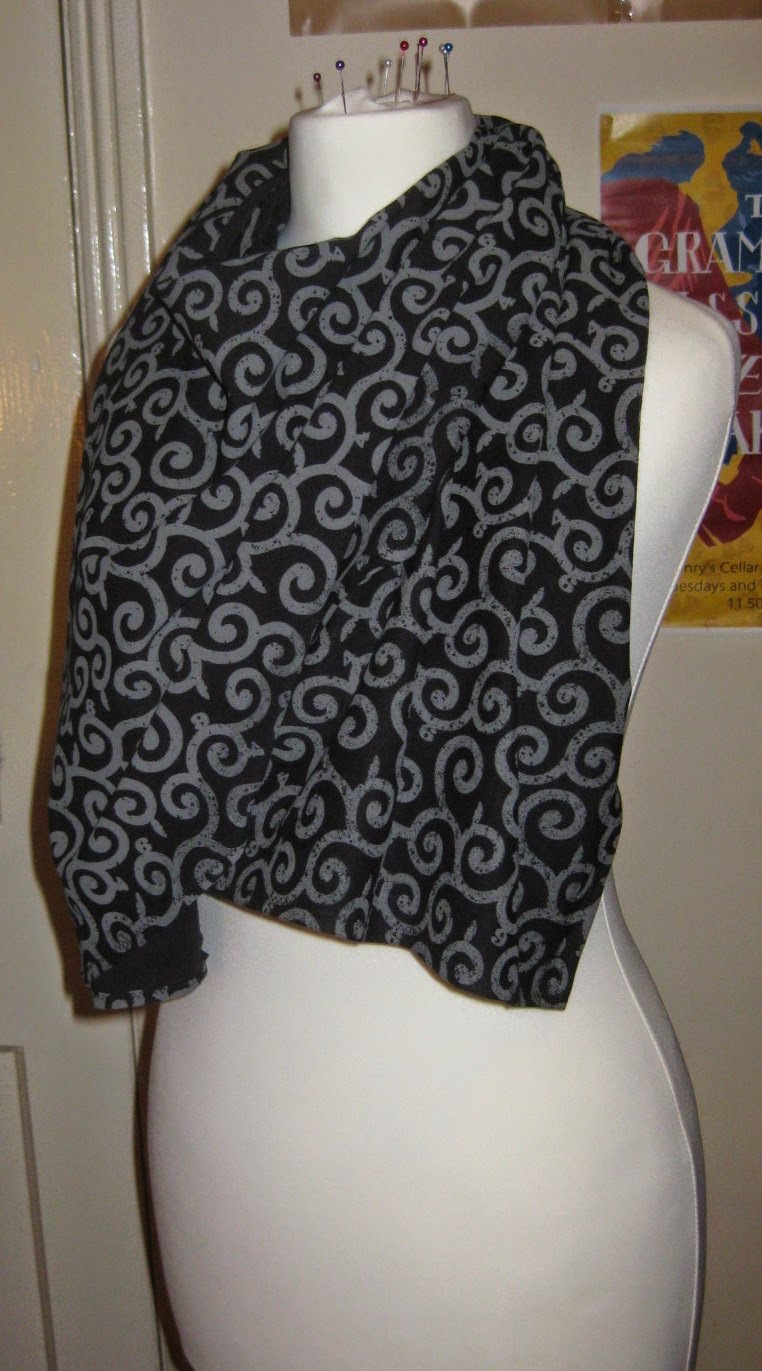
How great is the print on this fabric?

4649 Scarf - Japan all over
Guys, this scarf was for TapTapTap: the lady just oozes cool. She just debuted her company Old Kent Road at The Place.


TapTapTap had a proper 4649 scarf. Had. Apprently it went walkabout on the train and the brand's remaining supplies were long gone. Sad times. Naturally, we thought we could manage a broadly similar thing by buying a t-shirt and refashioning appropriately. (We - B was in on this as well)

Evidence it once was a t-shirt


The pattern is Two Way Stole from Natsuno Hiraiwa's Shape Shape. Once again,the pattern behaves very differently depending on which fabric you use. That might be a running theme at the moment, don't you think?

Shape Shape two-way stole


EDF Plushie
You know this guy actually has a name?! It's called Zingy - and it somehow has a merch shop, a pattern on Ravelry and a whole selection of bootleg replicas floating around eBay and Etsy. Do you find it a bit odd that there's a whole handmade economy growing around the cute mascot of a corporate energy firm?

EDF Zingy Plushie
Anyway, you remember my highland cow from July? Turns out it was a big hit with the grandparents. Anything cute, they will adore. I have it on grandfather's athority that the cow is only allowed to cosy the teapot on special occasions. Otherwise it's got its own place on one of those mantelpieces that all grandparents reserve for special things.

Zingy getting stuffed

The grandparents have a soft spot for Zingy. EDF flyers can be spotted about the house. I had this idea a while ago but dismissed it so I could avoid giving people too many me-made things as Christmas gift. But as mid-December came along, and the deadline was drawing closer, I knew that this was the only good thing to get for grandparents. I mean come on.

Pattern pieces
 So Amazon ond Plush Addict came to the rescue with fast delivery and an insane selection of orange fabric. The colours are a bit off in these photos but please trust me that a lot of thought went into finding the right shade of orange. I borrowed a machine, drafted a shape with B and sculpted/improvised the point on top.

This guy is bigger than expected, but I think he's a success.


That's it for now, more for you soon!
K

Tuesday, 28 October 2014

Shape Shape again

Procrastination is an ugly thing.

I sat on this project for a year, then cut it out and sat on it for another year, by which time I'd forgotten everything about the pattern. In some mad and fleeting moment, I got it sewn up in a spare afternoon a couple of weeks ago.


It's the Sleeveless Scarf Blouse from Natsuno Hiraiwa's Shape Shape book, cut in a grey/blue chambray from La Petite Emelienne in Strasbourg (now closed down! :( ) the topstitching was just a random colour I had in my thread stash at the time, I think it's a midnight blue.


Having finished it, I can say the pattern is a little boxy and runs to the top of my hips. This was planned to fall into the category of "quirky but socially acceptable officewear", but it's a bit shorter and a bit boxier than I'd have liked.

The scarf neck is two pleated pieces of fabric attached at the shoulder, which should be artfully draped around your neck. I made my scarf from jersey and didn't hem it so it rolls in on itself a little.


I also switched out the buttons for some snaps because it seemed like they would suit the simplicity/minimalist aspect of the rest of the shirt. Big buttonholes seemed like they'd be a bit too heavy.


Incidentally, I'm experimenting more with sewing these on by machine. Generally I choose handsewing but machine stitching might be faster and more secure. Thoughts?

K

Wednesday, 9 April 2014

The 'Oh yeah, that one!' tee

"Do you remember that crazy step from tap today?"
"Errr, no...what are you on about?"
"You know, that one from the combo we did?"
"The one to Kanye West?"
"No, to Al Green, with the weird body percussion thing"
"..."
"Do you remember any of the combo?"
"No."
"Okay, well it starts like ****, and then something else happens... but I don't remember the next bit...do you?"
"Are you sure we didn't do it last week instead?"
"Maybe, we definitely did it today though"
"Mm. Can you count it?"
"No."
"Can you remember anything about it?"
"You start facing the front, then you go over there, and then over there, and then sideways and then I think you pickup, step, heel, three times and then there's a turn..."
"..."
"It's a bit twisty...looks like you're skipping over your own legs..."
"..."
"it goes dededede, dededede, dededede-yatayatata"
"Oh yeah! That one!"


Looking pretty straight...
A little bit back to front, a little bit twisty, a little bit confusing....


Such is a common conversation in the pub post-tap. Everyone has different ways of remembering the combos and techniques, but trying to write it down or explain it to someone else is pretty much impossible. Then you start miming, counting, signing, gesturing odd directions to try to jog the other person's memory. Sometimes it feels like you live in this Fry & Laurie sketch.

Sigh.

So that's the deal. If you see this top in person and ask nicely, I could show you the crazy step it's actually named for (provided I don't fall over or get embarassed or both). But here in blogland it will forever be known as the 'Oh yeah, that one!' top.


It's the newest part of the Spring Race Challenge. It's my 3rd Twist & Drape Blouse from Natsuno Hiraiwa's Shape Shape book. This one is made from jersey, I eliminated the CF closures and modified the sleeves a bit (a lot). I love the drape of the top, but neither England nor Stockholm in the spring really allow for a drapey vest top, so sleeves were duly added!


Loose definition of the term "backwards"

Because I actually think this is backwards...
but can't really remember...

The fabric is from Girl Charlee, and some scraps of perma-crinkle jersey I got from Strasbourg. All in all, it's nice and bright. Plus, I can wear it backwards!

I stabilised the neckline using twill tape too, and the flat-fells are looking bloody lovely. The hems are left as raw edges.


I'm yet to decide if this is actually going to be good exercise wear.
Easy to clean/care for? Check.
Colourful? Check.
Comfy and easy to move? Check.
Aerated? Check.
Shifty and bouncy? Errr...

Anyway, no credit for guessing what we're moving on to next. After a tip top tap top, it's gotta be tap trousers!

K

Thursday, 20 June 2013

Let's Twist Again!

I made the Twist & Drape top again! Much like the last version, this one is based on a pattern from Natsuno Hiraiwa's book Shape Shape.


It's made in some sort of drapery loose-weave fabric that I pilfered from the London swap in April. This was the only piece of fabric I knew instantly how to use, so thank you whoever left it! The drape is a little limper than the previous version. I like it a lot, the cowl/twist falls in a very different way and it's a lot easier to leave this one a bit messy. The colour is gorgeous, it's almost a sea blue. In some lights it's very blue, some lights it's a husky grey colour and in some it's almost green. What a great bit of fabric!

This time I used much smaller buttons. I like how they're near invisible on this top, but it would have been nice if they were added with a contrast thread.

The pattern stayed the same. I'm thinking of making the top a third time and adding some kimono/grown on short sleeves. Good idea?

Also, I'm still a little cheesed off with the pattern. The flat felled seams won't stitch straight and the bias tape never looks good. What is going wrong? Fabric just keeps shifting around under all of the curves. There has been a lot of rippling and ripping. Grrrrr.

The next version will probably have a contrast effect so I want to get this neat. Has anyone else attempted this pattern? Generally any tips for making these curves look pristine?

Should I just line it?

Sunday, 21 April 2013

Don't get shirty with me!

I decided to do a bit of a Robson & Jerome today so here are some pics from up on the roof.

Possible future picnic location...

I decided to test out the Twist & Drape Blouse from Natsuno Hiraiwa's Shape Shape. I love the stuff in this book, partly because I'm hoping I won't need to adjust any of the patterns, falling squarely into the S category.

Front - bad choice of undershirt...but hey


Back

I love the fact this can be worn both ways around too.
Back to front

Front to back

All the seams are flat felled, with a little bit of blue topstitching too. Part design feature, part thread shortage.

I tried a new interfacing with this shirt, which is a lot lighter and softer than the one I've used previously. It's absolutely fantastic, definitely going to be used in a lot of facings because it doesn't distort the drape so much. I've heard a lot of people go on about using the right kind of interfacing but  this is the first time I've actually understood why.

The fabric is an embroidered polycotton I got in a swap with Lisa at Small Things. It has been sat in the stash for a while but since the wrong side is on show a lot for this blouse, it works really well.

Instructions in the book are minimal. One BIG thing I'd draw attention to is the instructions for finishing the raw edges. I think they're overly fiddly and really didn't lend themselves well to my style of finishing. It would be a lot easier to bind/finish the whole edge before adding facings. I got a bit lax and fudged it, thinking it would be fine. Unfortunately the dodgy area below is slap bang in the middle of the drapey bit so it's going to pay to be a lot neater next time.


Now, the question is...how on EARTH do I style this? Colours? Jacket/hoodie? Grey's not my strongest colour so what can I do? Ideas please...

Right, now to take some finishing work and tea to the park

K

(Yesterday's meetup was fantastic, but I'm suffering a bit of a fabric hangover...more comprehensive post to follow! Massive thanks to House of Pinheiro for organising, we met so many amazing people!)

Sunday, 10 February 2013

Two-Way Stole Your Heart Away

Though I haven't really posted any projects here, I have been working away on quite a few items. Firstly, there was Christmas and several handmade gifts to get ready (boy oh boy will I plan that more effectively in the future and start planning in August!).

Now I've got a request make, office wear (not sure how this hobby is going to get outed to my colleagues) and a project backlog to all get on with. Not to mention that my sewing table looks like this:


So the machine is basically out of action for a while.


But here's something I managed to make in the last month, squeezed out of the scraps of a Christmas gift:


The fabric is a sweater knit from MacCulloch & Wallis, so I'm amazed how much I got out of it. The price seemed steep, even as a gift, but it's turned out to be really good value!


The pattern is the Two-Way Stole from Natsuno Hiraiwa's book Shape Shape. The construction is fairly basic: two pieces joined with a French seam, and then hand hemmed using the knit's own yarn. The hem technique is basically improvised. The published image of this pattern was the whole reason I wanted the book, and was actually really surprised to see that no one on the web had really made or shown it off before. Not even Carolyn, who seems to be the anglophone press officer for Hiraiwa.


I hesitated in making it after seeing the pattern piece, as there is space for a large gap in the back. The book's model shots hide this fact really well, so just a warning, this is what the back looks like:


Still, the aim of the book is to sew clothing and accessories that can be worn in a variety of different ways. So what sort of things can be done with the stole? Here are a few ideas that are the result of buggering around with it on a Sunday afternoon. Just a warning, some of these may look better if I weren't in a black tee and jeans.

Well the obvious variations are to alter the drape in the front. Here you go from something very square with the excess folded under, to a ripple-y style with the excess rolled over the top. If you fold the excess under, you've probably got good scope to put together some sort of lapel effect.


Then you have the scarf/cravat, which probably works well with jackets.


Then, you've got The Poncho. Not a fan of ponchos. Similarly the Off The Shoulder. I guess that's useful if I ever get invited to a toga party...


So how about making use of the asymmetry? You could tuck one corner into the armhole of the opposite side, or tie them both up. I really like the second one, I can see that working well.


A lot of the book suggestions are to create draped effects so knots would work really nicely in a lighter fabric. A word of warning though, this fabric really doesn't lend itself well to any of that. So leaving the ends out isn't really an option.
See?  
Finally you'll need some pins, but making a v-neck cardi-vest works really well with this pattern. You could possibly even make some lapels if the fabric behaves well.


I hope some other sewists will be making this up in a different weight soon because I need new ideas!

On an interesting cultural note, I found this article today about translation and its far-reaching effect on everyday life. It reminded me how translation can be used to create a whole new canon in a specific subject in a target language, and I think this is what's happening with Japanese sewing books. Shape Shape as a translated title is an obvious mirror to another Japanese series Drape Drape, though the publishers and authors are different in each case. I'd bet that the translator is the same person for both sets of books, and they're essentially creating their own series of anglophone sewing books that encapsulate Japanese design and style. Any thoughts?


K

PS: The white tee in the images is the Side Gather Top from Burdastyle 09/2012 #130. Good pattern, definitely recommend it. Didn't follow the instructions, but FehrTrade has an excellent tutorial to finish the neckline.